
Committed to Net-Zero Carbon Emissions by 2050
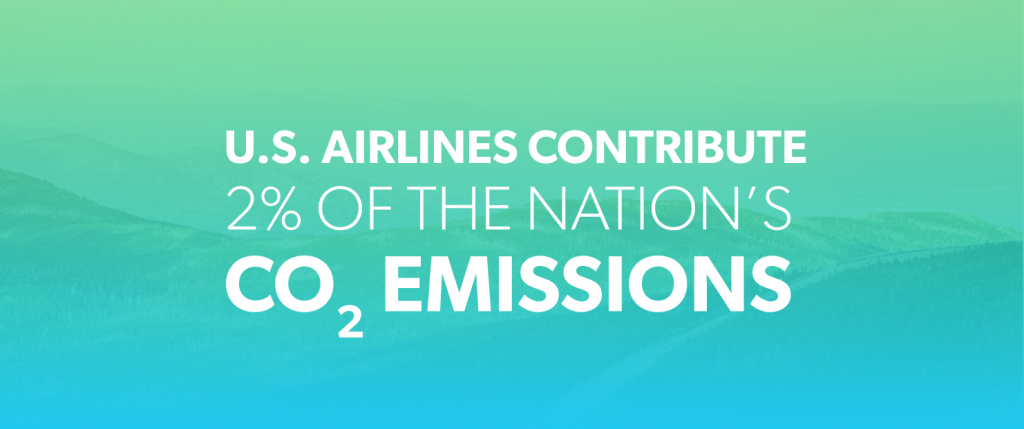
U.S. airlines transport over 2.7 million passengers and 61,000 tons of cargo per day while contributing just 2 percent of the nation’s greenhouse gas emissions, and we are continuously investing in more fuel-efficient aircraft and engines, developing sustainable aviation fuel (SAF) and implementing more efficient procedures—both in-flight and on the ground.
U.S. airlines improved their fuel efficiency (on a revenue ton mile basis) by nearly 150 percent between 1978 and 2024, saving over 6.7 billion metric tons of CO2. That’s like taking more than 31 million cars off the road each year since 1978.
Related News
Scaling Up Sustainable Aviation Fuel
The U.S. aviation industry has taken a leadership role in the development and deployment of sustainable aviation fuels (SAF). A4A and the Administration have set a shared “challenge goal” of making 3 billion gallons of cost-competitive SAF available to U.S. aircraft operators in 2030.
To continue that commitment to the environment, major U.S. airlines have pledged to working across the aviation industry and with government leaders in a positive partnership to achieve net-zero carbon emissions by 2050. Achieving that goal requires continued achievements in fuel efficiency through investment in new aircraft and modernized air traffic management infrastructure, combined with a long-term transition to lower carbon SAF.

As an initial milestone and market signal for SAF, U.S. airlines have also pledged to work in partnership across the aviation industry, with the energy sector, agriculture sector, customers of air carriers, and with government leaders to make 3 billion gallons of cost-competitive SAF available for use in 2030.
In addition to achieving net-zero carbon emissions, our commitment to SAF harnesses the drive for American energy dominance and supports American farmers and the agriculture community through the production of SAF and boosts innovation in renewable fuel production.
We’re seeing progress on SAF availability. In the first eleven months of 2025, U.S. SAF availability surpassed 237 million gallons, the majority of which was produced in the United States. That exceeds the sum of all previous years of SAF combined. This is tremendous progress, but the pace of development lags what is needed to achieve the ambitious aviation goals.
U.S. airlines continue to call on policymakers to partner with us by implementing the following measures:
- Enhancement of federal and state SAF tax credits
- Leveraging the Administration’s commitment to modernization of the air traffic management system to enhance efficiency
- Continuation and expansion of public-private aviation research and development programs
- Continuation of the Carbon Offsetting and Reduction Scheme for International Aviation (CORSIA)
- De-risking of private investment into new SAF production capacity and enabling technologies such as new fuel production pathways, carbon capture and sequestration, and regenerative agriculture
Click on the links below to find out more about our member airlines’ sustainability initiatives.





Close Site Search
Search Icon Search
Filter By Topic:
0 results